
A Relentless Advocate
By Rachel Crowell
March 2026
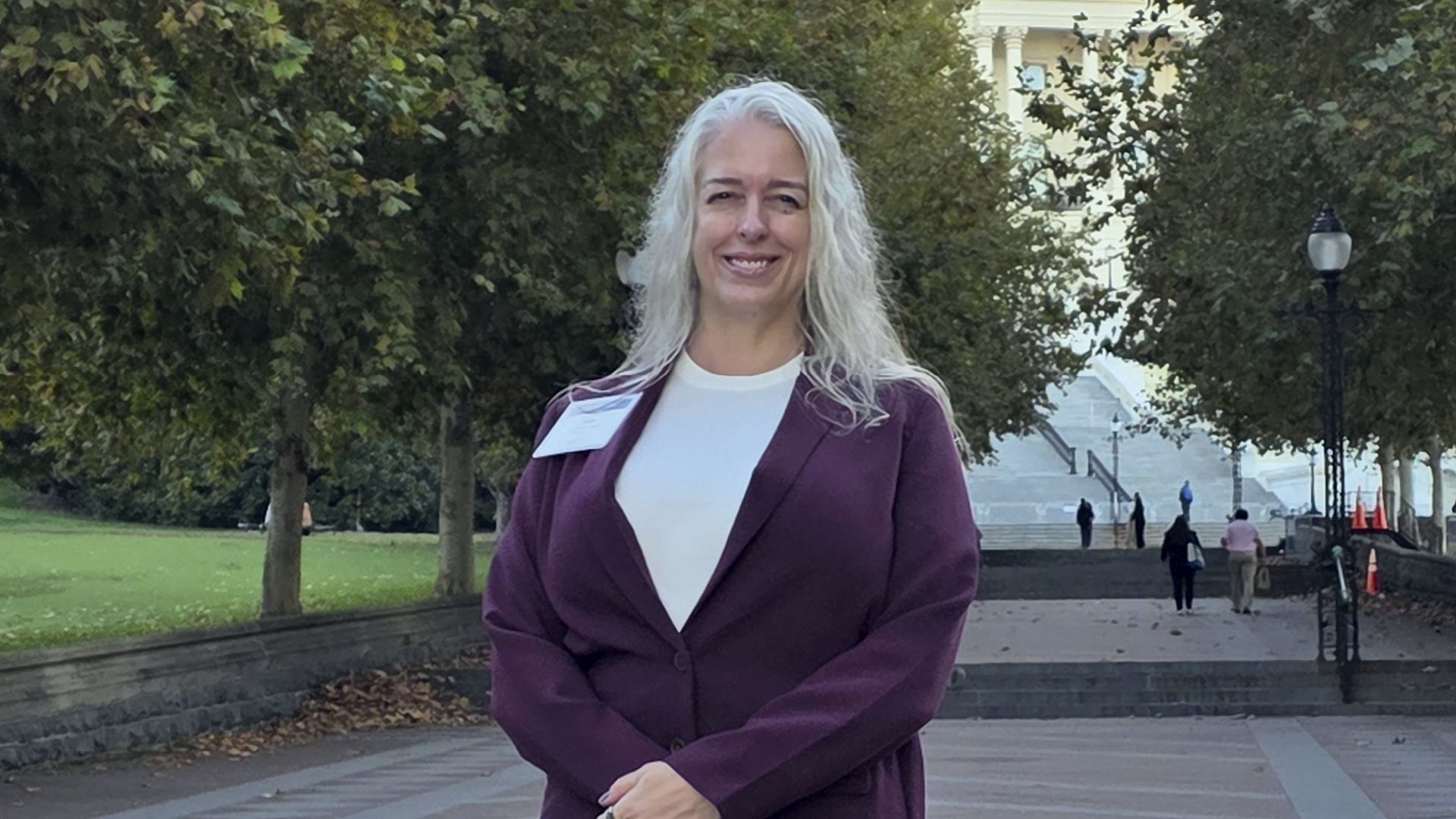
In 2025, Sarah Evans Zalewski, PhD, LPC, RPT-S, earned her registered play therapist-supervisor designation. Those four letters after her name quietly summarize much of her purpose as a counselor and leader: helping children and adolescents both directly and by teaching, supporting and supervising counseling students and new school counselors.
In addition, Evans Zalewski, who received ACA’s 2025 Robert Rencken Emerging Professional Leader Award, promotes counselor well-being and retention within the field. She does so by researching burnout, self-care and supervision, while also advocating for improved working conditions.
Evans Zalewski is an assistant professor of counselor education and family therapy at Central Connecticut State University (CCSU). Her scholarship is rooted in real-world experience: For seven years, she was a counselor at Illing Middle School in Manchester, Connecticut.
While Evans Zalewski didn’t originally plan to swap school counseling for counselor education, she discovered her passion for teaching when she was pursuing her doctorate in counselor education and supervision from the University of the Cumberlands. While that university is based in Kentucky, her doctoral program was primarily online. To fulfill a program requirement, she served as an in-person teaching assistant at a local university, CCSU. “They hired me as an adjunct and I never left.”
Over time, Evans Zalewski realized that by expanding her repertoire to include teaching counseling students and supervising new counselors, she could, by extension, help many more children and adolescents than would ever be possible on her own.
Supervision Needed
As a researcher, Evans Zalewski studies burnout, self-care and supervision in school counselors, issues that directly affect counselors’ well-being and retention within the profession.
According to Evans Zalewski, school counselors are often tasked with excessive caseloads, even as new professionals, and receive much less — if any — of the intensive supervision their clinical counterparts receive. For instance, as a new school counselor, she had a caseload of 450 students — nearly double the recommended 250 students. While she had the benefit of working with an experienced school counselor and other colleagues who were mental health professionals, it still wasn’t enough. By contrast, new clinical counselors “undergo several thousand hours of supervised practice before you’re turned loose,” she says.
These stark differences are due to resource limitations and other factors, such as misunderstanding within public school systems about school counselors' responsibilities. For school counselors to be properly supported, other staff need to realize they’re mental health professionals who are often tasked with helping kids navigate serious or even life-or-death situations.
Evans Zalewski says she was “perilously close” to burnout when she left school counseling. “It’s much easier to prevent burnout than to cure it,” she says. “If you think you’re headed in that direction, it’s time to take some action. There’s no one self-care prescription I can give, but it’s evaluating your personal and professional boundaries. Are you taking time to have lunch every day? No human can live well working 80 hours a week, especially if they’re only getting paid for 40 of them.”
Her research has already shown that when school counselors receive administrative and clinical supervision, it can have a protective effect against burnout. In that setup, “You have an administrator who tells you what to do, but you also have the ability to talk about all the things pertaining to your students” in a safe place with support.
She’s currently researching questions about the relationships between burnout and self-care among school administrators and counselors in Connecticut. “It’ll be very interesting to see in school counselors and administrators how their relationships are working,” she says. “Are they both burned out? Is one more likely to be burned out than the other?”
Versatile Therapy for Kids
In addition to her professorship at CCSU, Evans Zalewski also has a private practice. She works with children, adolescents and their families. Play therapy and cognitive behavioral therapy are her two main modalities.
“Thinking about how we think and the assumptions we make is the precursor to that full-blown pre-frontal cortex functioning that [kids] don’t have yet,” she says. For instance, she frames reducing automatic negative thoughts (ANTs) as squashing ANTs. “We talk about catching those ANTs and squishing them, because little kids like to squish things, and then replacing them with things that are more accurate and helpful,” she says.
When working with children and adolescents, as well as the students and new counselors she teaches and supervises, Evans Zalewski draws on two character traits she holds dear. “I am always 100% honest, even if my honesty is, ‘I can’t talk about that right now,’” she says. “I believe the best in everybody right from the start, and I usually don’t get disproven.”
Evans Zalewski has found that many children and adolescents find her approach to be a refreshing change from the status quo in their lives. Adults often only tell kids “whatever the grown-up thinks they need to hear,” she says. They also often don’t give kids the benefit of the doubt. “It’s fascinating to me, perennially, that grown folk are allowed to have a bad day and it’s just to be accepted, but when small people have a really bad day, they’re acting out, they’re being defiant,” she says.
In her experience, children and adolescents are often grappling with challenges the adults in their lives might not even be aware of. “I hate to blame a lot of this on COVID, but during that time, a lot of kids lost some important time where they learn foundational coping skills: How do we interact with humans in a face-to-face environment?” she says. That resulted in some adults and children having “really maladaptive ways to handle things,” she says, adding that unhealthy ways of coping can be more difficult for young people to unlearn.
According to Evans Zalewski, issues that may seem very adult — pressure to perform, politics and loneliness — are very real concerns that are having a tremendous impact on children and adolescents, often without their caregivers realizing.
Evans Zalewski notes that when she worked on a mobile crisis team, their call volumes would spike during the school year and lessen during summer months. “There’s a lot of pressure on children academically, and that’s been around for a long time,” she says.
Kids are also often attuned to broader concerns about the state of the world. “You wouldn’t think that someone who works with younger folks would spend as much time talking politics as I do, but that’s a real thing,” she says. Also, “Our kids are very lonely, and sometimes they don’t understand how lonely they are.”
A Digital World
While the time that young people spend on digital devices can create real issues, such as missed opportunities to form more in-person connections with larger groups of kids, it can also be a boon for counseling.
“Our kids, now they’re digital natives,” says Evans Zalewski, who’s board-certified in telemental health. She finds telehealth sessions valuably complement in-person ones and can even help expand clients’ access to counseling.
Weather, excessive travel times and the possibility of spreading minor acute illnesses are no longer barriers. “Not everybody can make it to my office, and that’s OK,” Evans Zalewski says. “I can do play therapy through the computer just as well.” She also notes that parents who are juggling the fact they need to be available during one child’s therapy while their other children need to be occupied elsewhere may handle that situation more easily from home.
According to Evans Zalewski, telemental health requires a different skill set. For instance, it’s more challenging to read people’s body language if you can only see them from the shoulders up. The solution, she says, is often for counselors to ask more questions about what the child is doing or how they’re feeling. Telehealth sessions can also introduce some boundary issues the counselor must handle in real time. Sometimes, “when we hit a therapeutic moment, especially with younger ones, all of a sudden, they want to rush into the bathroom to tell Mom, who’s showering, the thing they just learned,” Evans Zalewski says. “When that happens, I’ve learned to quickly disconnect.”
However, Evans Zalewski also notes virtual sessions can give counselors unparalleled insights into children’s worlds. “In the office, no one’s going to show me their favorite place to sit when they’re sad,” she says. Kids are also often more comfortable talking online and in their own spaces.
For young digital gamers, Evans Zalewski, who’s a gamer herself, even discusses games in counseling. “We talk about ‘How are you interacting with other people? In a lot of interacting with other humans, you’re interacting through a character. So, like, is the character you?’” she says. That can lead to work related to kids’ values, identity development and more, she says.
Future-Proofing
Ensuring the future availability of counselors for children and adolescents starts with taking actions that promote better training, well-being and working conditions for those counselors. Evans Zalewski is a big proponent of self-care and self-advocacy, two things she says counselors often encourage their clients to do but struggle to accomplish themselves.
There’s also a need for collective action, an idea Evans Zalewski embraced when she was president of the Connecticut Counseling Association. She’s proud of accomplishments she and her colleagues made, such as helping pass legislation so Connecticut could join the Counseling Compact. However, she says, better policies and legislation are needed on a range of issues, such as regulating insurance companies’ abilities to claw back payments already issued to counselors and legally mandated supervision for school counselors.
“There’s room for advocacy,” Evans Zalewski says. “Now we’re not going to be classified as professionals anymore. That doesn’t sit well. We have clinicians graduating with a significant amount of debt to get to where they are, and knowing the reimbursement rate is so low, they’re struggling. We still do this, and we will always do this, because counselors are people who want to help.” Still, she says, counselors themselves need help sometimes.

2461 Eisenhower Avenue, Suite 300, Alexandria, Va. 22314 | 800-347-6647 | (fax) 800-473-2329
My ACA Join Now Contact Us Privacy Policy Terms of Use © All Rights Reserved.