
The Call of Rural Regulatory Work
By Samantha Cooper
September 2026
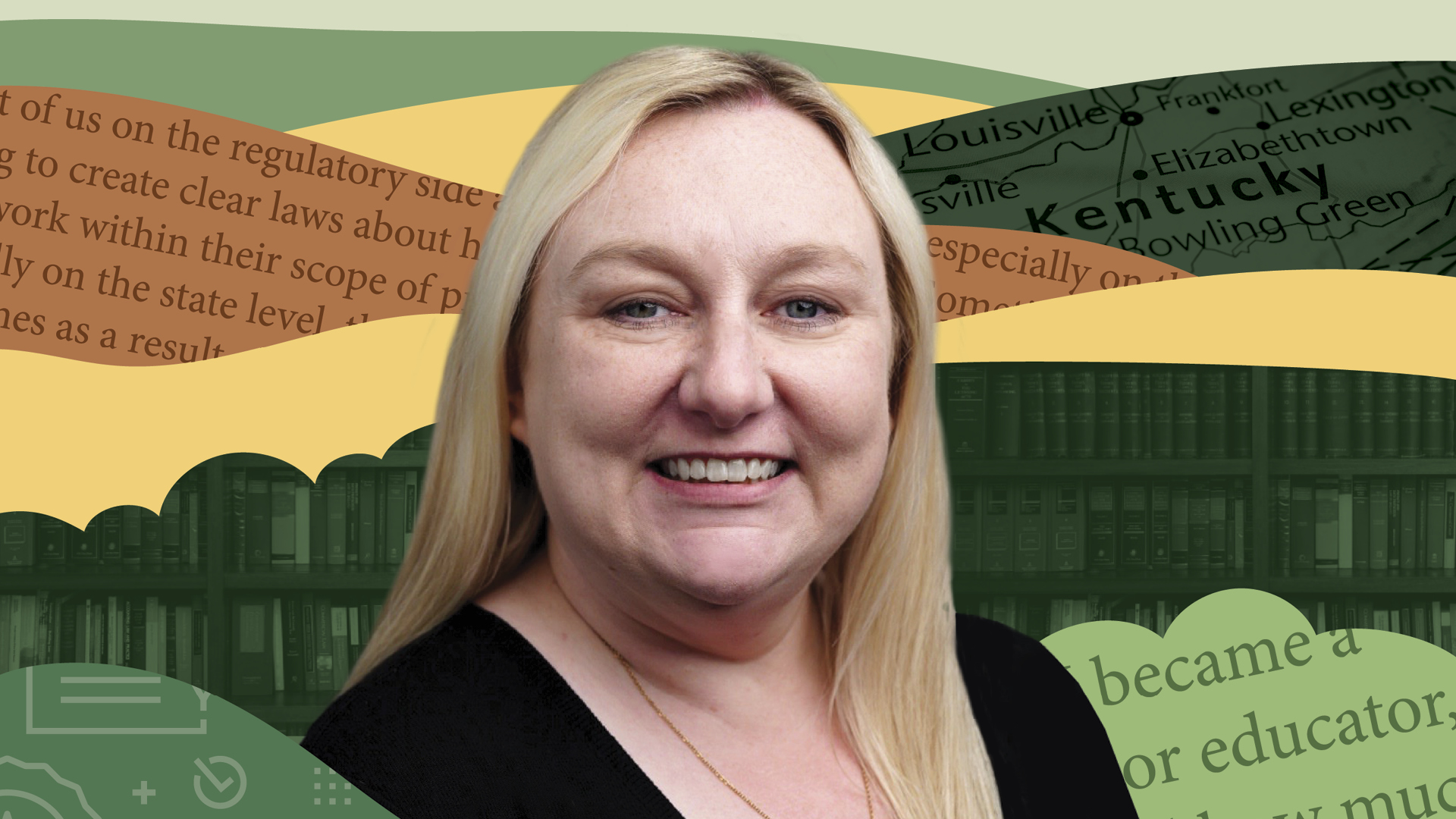
Regulatory work focuses on writing and enforcing the rules governing a certain industry. For many people in mental health professions, the idea of working to build the laws that govern those professions may seem intimidating or boring. But for others, like Andrea Brooks, PhD, LPCC-S, it’s a calling.
Brooks, who loves developing and studying policies, recently completed her term as Kentucky’s representative for the Counseling Compact. During her service, she was elected vice-chair of the compact’s executive board and served as the rules committee chair.
“To be in that room, where the rules and laws were written and created to make the compact official, was absolutely amazing. I’m so happy I got to be there. I’m proud I was able to set a precedent about the work and lay a foundation for the profession,” she says.
Fit for the Job
Brooks explains that she knows regulatory work isn’t for everyone, and if somebody who doesn’t enjoy it forces themselves to do it, they’re going to be miserable. She does wish, though, that more counselors would try to understand what she does, why she does it and how her work benefits the profession.
“Most of us on the regulatory side are also counselors. We are helping to create clear laws about how counselors can best and easily work within their scope of practice. For regulatory work, especially on the state level, the goal is to protect the public. Sometimes as a result, that work advances the profession,” she says.
Such regulatory work means ensuring counselors in her state and nationwide are keeping up to date with the evolution of the profession and not working with clients outside the services they are licensed to provide. Sometimes it may seem as though regulators are policing the profession or making decisions that appear nonsensical, but they have people’s best interests at heart, Brooks says. To best accomplish this goal, she has to “keep her finger on the pulse” of the profession and be passionate about the work counselors are doing.
“My favorite part of the regulation process is going to national conferences, where people from all states come together and talk about the cool things they’re doing. I like going back to Kentucky and explaining these new ideas,” she says.
Saving the Children
Brooks grew up in Wolfe County, Kentucky, which has consistently ranked as one of the most impoverished counties in the U.S. While her family did fairly well for the area, things weren’t always easy.
Her parents divorced when Brooks was 10, and she had nobody to help her process her emotions. “I struggled. Looking back, I could have used a counselor. But counseling really wasn’t a thing where I lived. There was a lot of stigma surrounding it, and even though we could have afforded a counselor, it just wasn’t in the realm of possibility. The concept just didn’t really exist.”
She didn’t consider that she may have had trauma related to the divorce until she entered college and began taking psychology courses. At the time, the aspects of counseling she found most interesting revolved around helping children. Her undergraduate psychology courses helped her recognize her passion for working with youth and her desire to improve mental healthcare access in rural areas.
The day after her 21st birthday, she applied to work in a nearby children’s home that had been the subject of a recent class trip. She was hired on the spot as a direct care worker.
“The HR lady said that nobody had wanted to work there so badly that they turned in their application as soon as they were eligible. I loved that work, but I only stayed there until I graduated a few months later,” she says.
While her time there was short, she began working at a different children’s home soon after in her hometown. It was one of only two jobs there for which she was qualified.
“I don’t work clinically anymore. I supervise, educate and do regulatory work — but that home is where my clinical heart lives. There will never be another counseling job that fulfills me as much as that job did,” she says.
When the home was going to close, putting the children at risk, Brooks convinced the organization to let her stay and handle things. She ended up starting a new foster care program and did everything to keep it running; she was the case manager, program manager and counselor. She also recruited and trained the foster families. Eventually, she departed to work as one of the first school-based counselors in Wolfe County and left the program in capable hands.
Sweet Home Kentucky
As a school-based counselor, Brooks spent time creating new processes based on best practices while also counseling students.
Helping her community has always been a high priority for Brooks. She says she tends to work with a rural-minded approach because a lot of factors prevent people from rural areas from pursuing a counseling career. For example, schools lack the infrastructure to teach about counseling, and very few higher education establishments exist. While people can earn an online degree, a lot of people don’t have a stable internet connection in their homes, Brooks says. They have to go to the library just to log in to their classes, which can be difficult. Brooks described a community near her where the library keeps its Wi-Fi on even when it’s closed. People will hang around the parking lot, in their cars, at 8 p.m. just to use the Wi-Fi.
Then there is the issue of finding counselors to work in these communities. Due to the vast differences in quality of life, many counselors from urban areas don’t want to move, she explains. Counselors from other rural areas may understand the culture, but because they didn’t come from a particular community, people often view them with suspicion.
“There’s a culture, in many rural communities, where if you’re not from there, you’re an outsider and can’t understand them,” she explains. This culture also means many college-aged students don’t want to travel far to get a college education.
As such, it became important for Brooks to recruit young community members into the counseling program at Lindsey Wilson College (now Lindsey Wilson University), where she worked for nearly two decades. She continues that aim in her current position at Central Methodist University in Fayette, Missouri, where she is an associate professor for the master of science in clinical counseling graduate program, which trains people to work in rural areas.
Brooks also recognizes the challenges counselors in rural communities face. They may be expected to provide services for several communities for long periods of time and may not have the expertise a client is looking for.
“There is really an issue with the quality of counselors available in these areas. People can’t choose between a male or female counselor. They can’t choose somebody who is of their own race, religion or culture. They don’t have access to specialists,” Brooks explains.
The Passion
While Brooks misses some aspects of clinical work, she says she feels as though she has made more of an impact as an educator and regulator.
“Once I became a counselor educator, I realized how much more of an impact I could make. If I train somebody to become a good counselor, I had a role in improving all of their clients’ lives. With regulatory work, I can have a statewide impact,” she says. This passion keeps her going.
Brooks has been awarded several accolades over the years, including ACA’s Arthur A. Hitchcock Distinguished Professional Service Award in 2025 and the Kentucky Counseling Association’s lifetime achievement award in 2024.
“The awards are very nice, but they’re not the achievement,” she says. “They’re recognition for other achievements. It doesn’t motivate me to receive awards. It motivates me to see accomplishments.”


2461 Eisenhower Avenue, Suite 300, Alexandria, Va. 22314 | 800-347-6647 | (fax) 800-473-2329
My ACA Join Now Contact Us Privacy Policy Terms of Use © All Rights Reserved.