
The Search for Meaning
By Samantha Cooper
November 2026
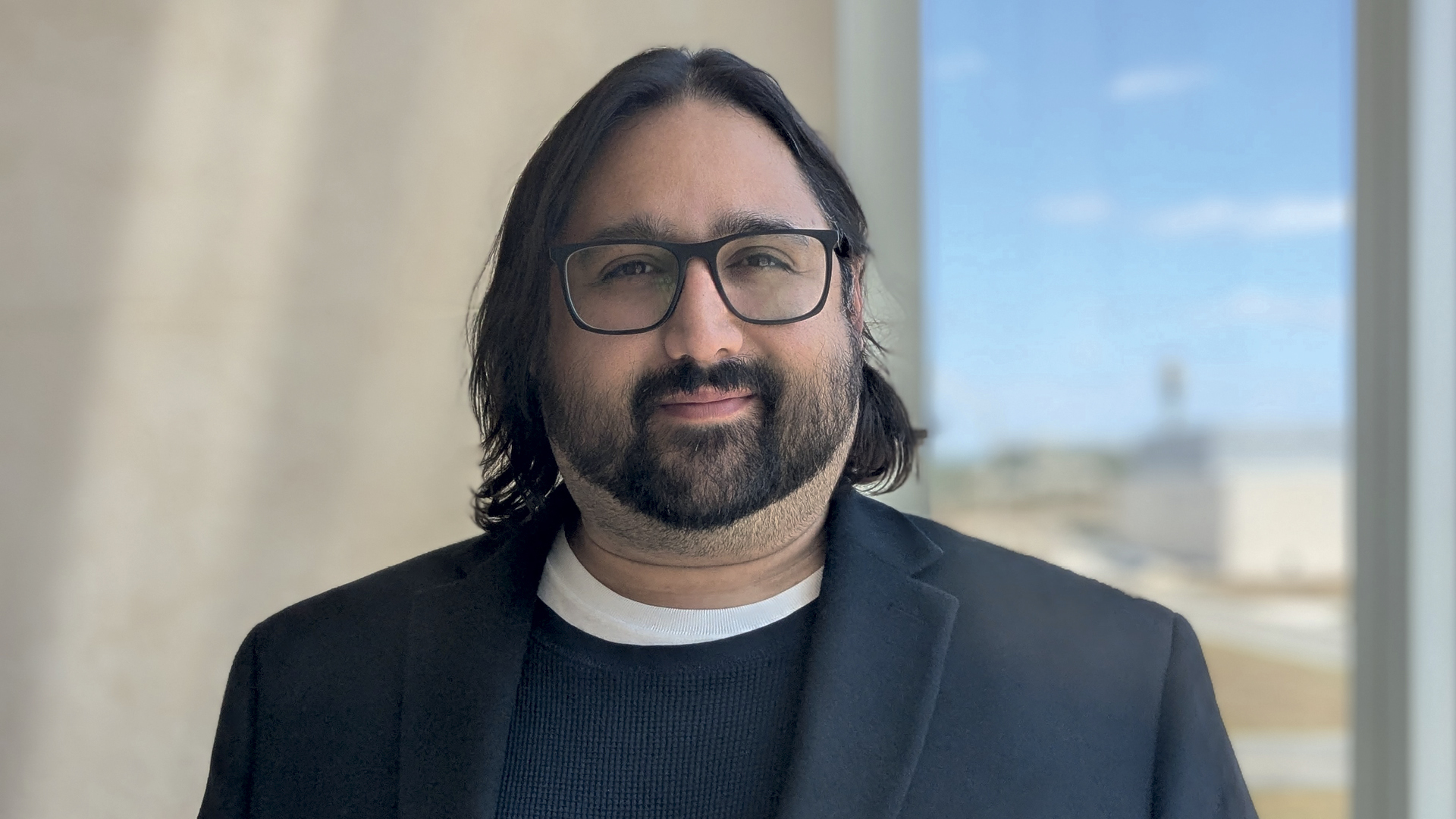
Like many professional counselors, Daniel Gutierrez, PhD, LPC, CSAC, did not grow up planning to enter the profession. As a Puerto Rican who grew up on the mainland U.S., he was raised in a family where education was valued but where financial security and responsibility to others often felt more immediate.
“My father knew education was important, but it was not given the same emphasis as the importance of making money. The goal was to get a job, support the family and get out of poverty. He used to say that you had to hustle to eat,” Gutierrez says.
Though Gutierrez did not originally see himself as a strong student, he was curious about the world and the forces that shaped human life. A psychology teacher at his high school in Orlando, Florida, who gave him books and an opportunity to take an Advanced Placement psychology course, helped Gutierrez picture a future in the field and a way to connect it with his other passion: spirituality.
“Psychology asks how people heal and flourish. Spirituality engages questions such as where the divine is in our pain, what suffering means and how we make sense of our lives. Those big questions are my jam. They are some of my favorite things to think about,” he says.
Spirituality and Reality
The relationship between science and spirituality in Gutierrez’s work was shaped in part by his own experiences as a counseling client. He often encountered approaches that left little room for bigger, more existential questions and felt such approaches neglected his spiritual needs.
“When we focus only on the mechanics of techniques, we can miss the deeper questions people are carrying, like ‘What does this suffering mean? Who am I becoming? Where do I find hope, connection or a sense of the sacred?’” he says.
Gutierrez hopes to prove scientifically that addressing clients’ spiritual needs would benefit them. “I don’t think spirituality and science need to reconcile,” he says. “I don’t think that they’re enemies. They’re not the same thing, but they can work together. Science helps us understand things accurately. Spirituality can help us engage with the world more compassionately and more responsibly. Science can help us measure things, but how do you measure things like the quality of someone’s love? That’s where spirituality can help.”
This idea led him to partner with Stephanie Dorais, PhD, LPC, to co-author the ACA book The Space Between Us: Contemplative Counseling and the Art of Encounter.
The Art of Encounter
The Space Between Us is designed to help counselors integrate a contemplative approach in their work to address clients’ spiritual needs. What makes the book unique, according to Gutierrez, is the proposal of a contemplative counseling approach he calls the art of encounter.
“The art of encounter has two parts: a way of being and a way of doing. The book presents examples of evidence-based practices and how those can be incorporated with ideas like contemplative self-inquiry, meditation and prayer. This allows the counselor and client to build a relationship to the pain and not just extinguish it. Instead, counseling becomes a meditation for two,” he says.
Gutierrez says the research and writing process was long and difficult. He and Dorais didn’t want to write another textbook. Rather, they wanted to write a book that was informative, entertaining and accessible while also ensuring they honored the dignity of the clients presented in the case studies.
When writing the book, they also knew they had to appeal to several different, contradictory audiences without reducing their beliefs: skeptical counseling professionals, anti-religion folks who wanted scientific rationale, and anti-science spiritual people.
“We didn’t want to say you could meditate away your bipolar disorder or that yoga could make it so that you would never feel sad again. It’s quite the opposite. The process was complicated. It involved a lot of research and a lot of pulling from our own lives and experiences. There were a lot of readings of spiritual traditions. But once I had all the material, I could write all day. There was joy in the work,” Gutierrez says.
Interdisciplinary Education
Gutierrez has also found joy in his work at Virginia Commonwealth University, where he is professor of counseling and special education. He is also the assistant vice provost for the school’s convergence lab program. The program unites students, community partners and faculty from different disciplines to find solutions for the world’s “wicked problems,” which include topics such as climate change, artificial intelligence and mental health, he explains.
Gutierrez helps lead the initiative’s mental health-related focuses. He recently worked with counselor educator Patrick Mullen, PhD, on programs to address mental health issues in schools. Neurosurgeons, neuroscientists, public school officials and others brainstormed ideas on how to educate and train the next generation of counseling professionals.
These interdisciplinary conversations are essential because Gutierrez believes mental health cannot be separated from peoples’ lived experience and social conditions.
Beyond the Classroom
As an educator, Gutierrez encourages his students to learn from, work with and live within the communities they serve to build lasting relationships. He believes this will help his students better understand the issues their clients face.
He also hopes he can get his students to recognize textbooks’ limitations when it comes to helping people. “There is no individual well-being without community well-being. We, as counselors, have to think larger. We need to have this awareness about the bigger picture and work alongside these folks so that our science can start showing that,” he says.
Gutierrez has received several awards for his work and research, including the ACA Fellows Award in 2025 and the lifetime service award from the Association for Spiritual, Ethical and Religious Values in Counseling in 2024. He was also chair of ACA’s human rights committee from 2019 to 2021.
He currently has a private practice and works as a contemplative training guide at the Living School, which offers education in the Christian contemplative traditions of Richard Rohr. He is still seeking answers to life’s many questions and helping people who need it.
When he started his journey, Gutierrez never thought he would actually make his living as a counseling professional, so he is grateful for the opportunity. “When I started counseling, I had imposter syndrome. I thought I was too damaged and that I would be bad at it,” he says. “But it all worked out even better than I imagined. I never thought I would be in the place I am now. If I were to map it out, it would just be a long road of these cul-de-sacs. I go forward, loop around, go forward again and then loop back around. I’m still on the journey and it’s gratifying.”


2461 Eisenhower Avenue, Suite 300, Alexandria, Va. 22314 | 800-347-6647 | (fax) 800-473-2329
My ACA Join Now Contact Us Privacy Policy Terms of Use © All Rights Reserved.