
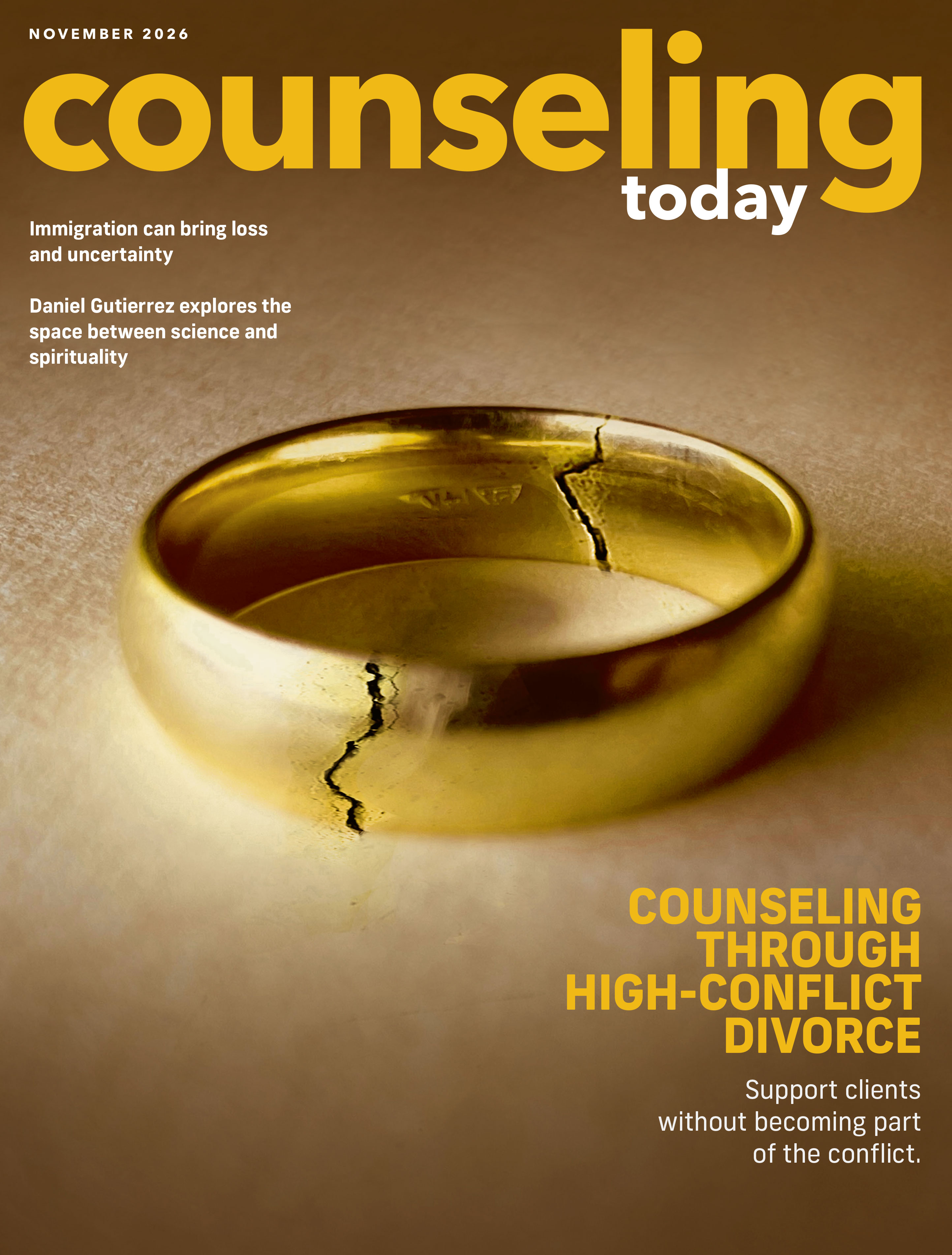
Counseling Through High-Conflict Divorce
By Dara Chadwick
November 2026

Some marriages end peacefully, with shared recognition that partners have grown apart. In others, betrayal, infidelity or complex family issues may shift an “ordinary” divorce into a high-conflict one. Working with couples in high-conflict divorce can present unique challenges for counselors.
No official definition of high-conflict divorce exists, yet it’s something counselors can often sense, says Myra Wilkinson, PhD, LMFT-S, owner and clinical director of Wilkinson Family Therapy and Self-Care with Myra, core faculty in the counseling program at Grand Canyon University and president of the International Association of Marriage and Family Counselors.
“You can feel the tension in the air,” Wilkinson says. “If one says the sky is blue, the other says the sky is pink simply because they are unwilling or unable to reach resolution.”
Kristin Little, LMHC, who owns a private practice in Seattle, sees high-conflict divorce as one in which individuals are unable to take in new information. “They’re not focused on problem-solving,” she says. “They may be unable to contain their anger at their spouse. Lower-conflict partners may have similar high emotions, but they’re able to orient toward problem-solving.”
Little is trained in collaborative divorce coaching. “In therapy, clinicians help clients process their emotions with more range,” she says. “In coaching, there’s more containment. We help clients create boundaries around emotions and not bring them into the conversation.”
Michael S. Jones, LPC-S, NCC, BC-TMH, owner of Renewed Vision Counseling Services in Searcy, Arkansas, and professor of counseling at the University of the Cumberlands, says he looks at patterns in the couple’s relationship. “When you have two people who are exercising bad judgment, especially when children are involved, that’s when I’d consider the situation high conflict,” he says. “Elevated anxiety, planned retaliation, poor social media behavior and acting out of character to prove something to the other person are all evidence of high-conflict patterns.”
Children and money are often involved in high-conflict divorces, Jones says. Katie B. Connell, partner at Connell Cummings LLC, a family law practice in Atlanta, agrees. She also notes that divorce stress can exacerbate underlying mental health issues. “Divorcing couples may be going through the worst thing they’ve ever been through,” she says. “I often encourage clients to see a counselor.”
Managing the Emotional Toll
Whether clients have been together for a year or 20 years, they’re grieving a life they thought they were going to have, Wilkinson says. Grief, depression, anger and denial are common. “It’s OK to feel those feelings and express them,” she says. “The concern is when these feelings interrupt normal routines and activities.”
Wilkinson encourages clients to use self-care practices to regulate emotions, stay present for their children and rebuild their post-divorce lives. “Parents may feel guilty for taking time for themselves, but your kids need to see you healthy,” she says. “I use a narrative approach focused on reauthoring their story by having them envision how they want their life to look after divorce.”
She also teaches the 5 Bs of Self-Care: Breath, Boundaries, Belonging, Belief and Balance, a framework she created. “The first thing is always intentional breath,” she says. “With that, you can decide the best next step for you in each moment.”
While divorce is an emotional process, it’s primarily a legal process, according to Little. Clients often need to make decisions when they’re not ready to do so. Ideally, feelings such as anger, sadness and longing become integrated over time, she says.
The Counselor’s Role
Wilkinson says counseling couples through high-conflict divorce is often about having them ask questions such as “How do we communicate properly?” and “How do we take care of our kids?” Sessions may cover co-parenting, communications, house rules and supporting clients as they transition to new roles and dynamics.
“My job is to be a neutral party,” she says. She helps clients understand what counseling is — and isn’t — so couples don’t enter the counseling relationship with conflicting assumptions about outcomes.
Wilkinson encourages counselors working with couples in high-conflict divorce to stay within their scope of practice. “Our job is not to save anyone,” she says. “It’s to provide our clients with tools they need to make healthy decisions.”
Jones sees counseling’s role in high-conflict divorce as helping clients move through rupture as safely and constructively as possible.
“I’m here to guide couples through this conflict,” he says. “I’m not here to patch things up or figure out what happened. I’m asking, ‘What is the best possible solution to get through this?’ If we can teach them to communicate and do no harm to each other, we’ve done a lot.”
Defining the counseling relationship is critical when children are involved, according to Little, a certified child mental health specialist who works as a divorce child specialist. Be sure clients understand the purpose of the relationship, its confidentiality rules and how information gathered may be used. For example, counselors must discern if they are offering mental health treatment or mediation and coaching as part of a parent’s divorce process. Build these distinctions into your intake process or explain them as part of your disclosure, she says.
“Therapy is treatment to help clients cope and develop skills for resilience,” she says. “By contrast, the child specialist role is more akin to mediation and coaching. In this role, the client is the parents and the family as a whole. You’re not doing any treatment, and the confidentiality is different.”
Protecting Children
When families with children experience high-conflict divorce, counselors must consider what the children witness, Jones says.
“A central clinical question is ‘What are you showing your children about how you care for them and for each other through this process?’” he says. “How do you want your kids to remember this? When children see you’re working together toward their betterment, that’s a win. They can understand that although this relationship didn’t work out, there’s still family here.”
Little says a divorce child specialist gathers children’s input to determine their understanding of the situation, their concerns and questions, and what they may want in the future. The process keeps children out of the divorce as much as possible while giving them a chance to weigh in on what matters to them, she says. “We don’t ask children to make any decisions,” she says. “This input gives parents goals to align on.”
Children need to see that their parents are leaders who will support them, Little says.
“Children should not have to navigate the in-between space,” she says. “Divorce may be a family crisis, but parents can still show consistency.”
Collaborative divorce work involves uncoupling people, separating them into individuals and bringing them back together as co-parents with new expectations, Little says. “Communication should be predictable and reliable and not disrupted by high emotions,” she says. “Co-parenting is an opportunity to redraw boundaries to individuate parenting and households rather than continue with the same routines and dynamics that may trigger conflict.”
She encourages counselors who work with children in high-conflict divorce to create procedures that minimize the risk of parental conflict undermining a child’s treatment. Co-parent coaching may help, she says.
When communication breaks down, practical tools can help create some distance. Structured apps allow parents to document communication and avoid disputes by making exchanges accessible to courts. Connell says school-to-school exchanges — where one parent drops off and the other picks up — may also help reduce conflict.
When Clients Aren’t Safe
Divorce is often stressful and traumatic. Sometimes, behavior patterns present in the marriage can escalate during the process. Coercive control, which can include isolating a partner from family and friends, controlling finances, stalking, violating boundaries, or threatening a partner or children, creates challenges in bringing the marriage to a peaceful resolution.“Assessment for coercive control is not a one-time step at intake,” Wilkinson says. “It is often not present or not visible in early sessions, and it may emerge as the work continues. I stay attentive to it throughout treatment and adjust the treatment plan when it appears.”
Coercive control is challenging in divorce, according to Connell. “It’s much harder to identify, to combat and to get people to understand,” she says. “Partners who use coercive control will often use the legal process as another form of abuse and control, including excessive motions and excessive attorneys’ fees.”
Another issue Connell sees is that the more capable parent is often asked to make adjustments because the other parent can’t or won’t. “This feels profoundly unfair,” she says. “A person may be trying to recover from that dynamic while at the same time having to negotiate and fight for themselves.”
Jones says abuse changes everything about the counseling approach. “When there is a pattern of abuse toward a child or parent, we’re not doing counseling at that point,” he says. The best and safest course of action may be to refer out to another professional or other resource with expertise in serving individuals in high-conflict or abusive situations.
Navigating Complexity with Support
High-conflict divorces are often complex for counselors. Wilkinson says she consults legal counsel when doing this work. “Before retaining counsel, letters from attorneys could feel frightening,” she says. “Having a practice attorney taught me that not every letter requires a response, and counsel is the one who helps you determine which ones do.”
She also consults the ACA Code of Ethics and maintains a network of peers she can consult on ethical questions. “I’ll reach out to these individuals and say, ‘This is what I think I should do ethically. What are your thoughts?’” she says.
Maintaining neutrality is critical. Wilkinson asks clients to describe what happened from their own perspectives. “That language is intentional,” she says. “That’s how we neutralize.”
Yet counselors are human, Jones says. It’s important to guard against taking sides in stories — whether intentionally or not. You may think “I can see why this person said this or did that.” But, he says, “The safeguard is recognizing that feeling.”
Jones says he may ask another counseling professional to serve as a co-counselor or consultant. “A key question I ask is ‘Am I seeing this correctly?’” he says. “Consultation may reveal something I’ve missed that I can bring back to the couple.”
Jones also sets ground rules with clients about his role. “I tell them I’m not here to take sides,” he says. “I’m here to document what I see and make recommendations. I always write my notes knowing they may be read out in court. I’m careful to keep notes factual, should partners try to use them against one another.”
Working with divorcing couples in high conflict isn’t appropriate for every counselor. Training and experience are critical, Wilkinson says, as is recognizing when a situation may be too much.
“If it’s out of your scope of practice, make a referral,” she says. “If the room is too chaotic and you can’t do your job, it’s OK to refer out. Our priority is to do no harm.”
Jones recommends that newer clinicians consult their supervisor or experienced counselors who work with couples. But even experienced counselors must assess their own emotional and practical capacity to take a high-conflict divorce case. “I may say, ‘I can’t put in the time I need to work with you right now, but I can refer you to someone else,’” he says.
Counselors must also understand the ecosystem of divorce, which may include multiple attorneys and extended timelines. “This can mean more than a six-month engagement. This can be a long-term process,” Jones says.
Little encourages counselors to understand the difference between collaborative and litigated divorce, as well as the roles of involved professionals. “Working with children and families can be challenging, but it’s so rewarding,” she says.
Ethical Considerations
In high-conflict or abusive situations, counseling may be contraindicated or may increase potential for abuse or harm. According to the ACA Code of Ethics, Standard A.11.c., a client may be referred out when it is reasonably apparent that the client is not likely to benefit or is being harmed by continued counseling, with the referring counselor providing pretermination counseling and referral to other service providers. Standards C.2.a. and A.11.a. speak to the responsibility of counselors to practice within the limits of their competence, and if an abusive situation exceeds their experience and professional competence level, it may be appropriate to refer a person to other resources. If professional advocacy is needed to assist in obtaining those resources, Standards A.7.a. and A.7.b. state that professional advocacy may be employed to assist clients in obtaining resources necessary for their growth and development with prior permission and upholding client rights to privacy, autonomy and confidentiality. Counselors should also be mindful of Standard A.12 and be careful they are not abandoning or neglecting clients in counseling; they should always use an ethical decision-making model and consult with other professionals as they make the ethical decision that most promotes the dignity and welfare of the client (Standard A.1.a.) and avoids the most harm (Standard A.4.a.).

2461 Eisenhower Avenue, Suite 300, Alexandria, Va. 22314 | 800-347-6647 | (fax) 800-473-2329
My ACA Join Now Contact Us Privacy Policy Terms of Use © All Rights Reserved.